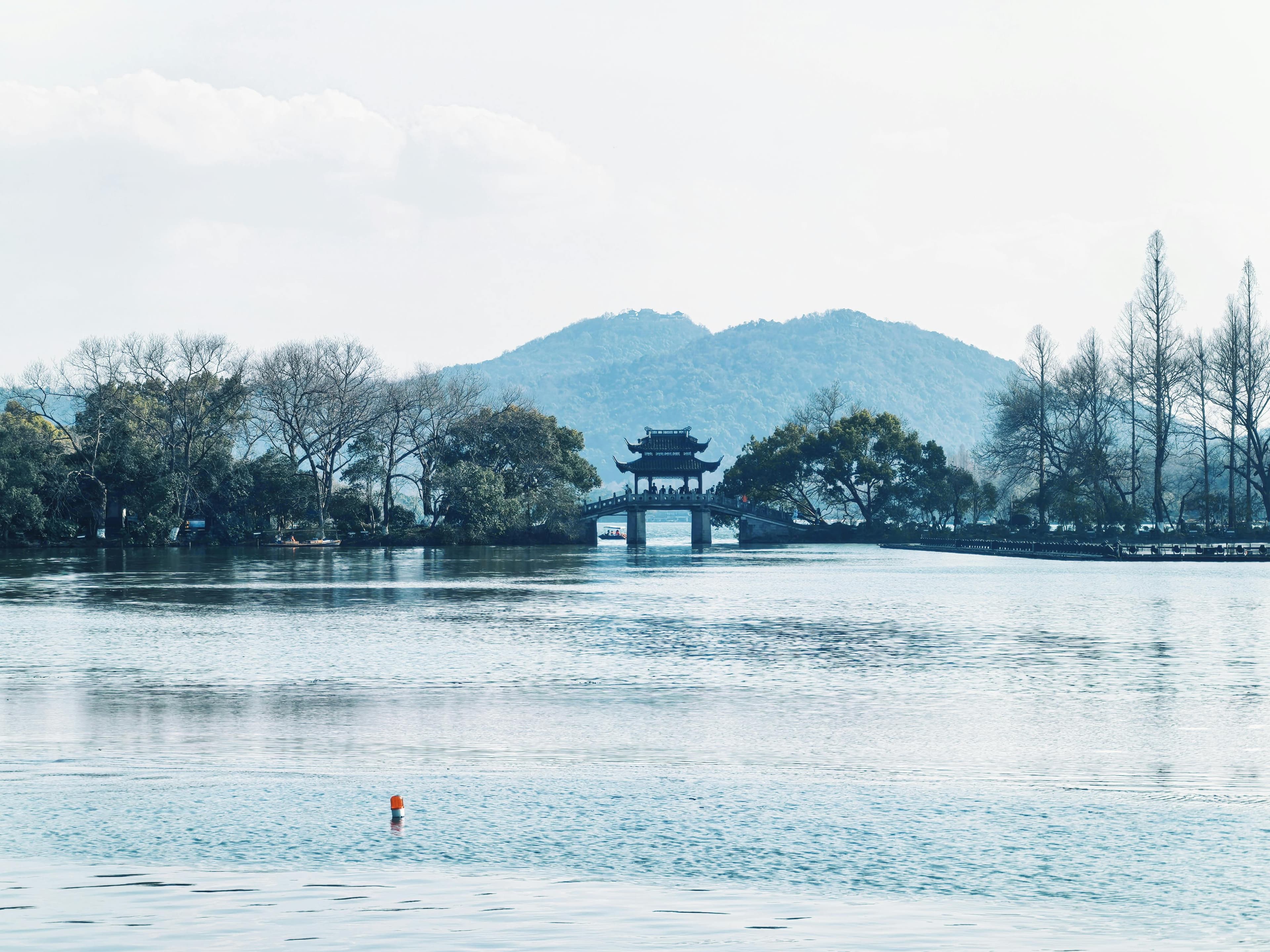
West Lake — the obvious place to start
West Lake (西湖, Xīhú) is why most people come to Hangzhou, and it earns every bit of the hype. The lake has been a cultural touchstone for over a thousand years — poets, painters, and emperors all left their mark here. It is also a UNESCO World Heritage site, inscribed in 2011 for its landscape design that blends natural scenery with man-made elements in a way that influenced garden design across East Asia.
The full loop around West Lake is roughly 15 kilometers. You can walk it, rent a bike from one of the many stands along the shore, or take an electric scooter. The Su Causeway (苏堤) on the north side and the Broken Bridge (断桥) on the northeast corner are the two most photographed spots. For the classic postcard view of Three Pools Mirroring the Moon (三潭印月), you need to take one of the boats from the main wharves — the central island is only accessible by water.
Go early. Like, really early. By 9 AM on weekends and holidays, the lakeside promenades are packed with tour groups. If you can get there by 6:30 or 7 AM, you will have the causeways largely to yourself, plus the morning light over the water is genuinely beautiful. The Leifeng Pagoda (雷峰塔) on the south-western shore offers the best elevated view of the whole lake — it was rebuilt in 2002 on the ruins of the original pagoda that collapsed in 1924, which itself dates back to 975 AD.
Evening is the other sweet spot. The musical fountain show at the lakeside plaza near Hubin Road runs several times a night depending on the season (usually 7 PM and 8 PM). It is free, touristy, but genuinely impressive if you have not seen one before. Afterward, walk along the Beishan Road waterfront where the historic buildings are lit up and street vendors sell local snacks.
Useful resources: The official West Lake scenic area website posts current opening hours, ticket prices, and any temporary closures. Trip.com lists boat tours and combo tickets. For independent reviews and recent visitor photos, check Google Maps or Dianping (China's Yelp equivalent — search 西湖景区).
Longjing tea country
Longjing (龙井, Dragon Well) tea is one of China's most famous greens, and the villages where it grows are a short ride west of central Hangzhou. The core growing area covers Meijiawu (梅家坞), Longjing Village (龙井村), and Wengjiashan (翁家山) — all within the West Lake scenic zone. Spring harvest season (late March through April) is when things get interesting: farmers are out picking, the smell of fresh tea fills the air, and prices spike because everyone wants the pre-Qingming crop (明前茶), picked before the Qingming Festival in early April.
You do not need a tour. Take bus Y3 from downtown or a DiDi to Meijiawu village. The main road is lined with tea houses and farm stalls offering free tastings. This is normal — taste first, buy later if you want. A few things to know: real Longjing from the designated West Lake production area costs significantly more than "Longjing-style" tea grown elsewhere. If someone offers you dirt-cheap Longjing right next to the plantation, it is probably not from here. That said, perfectly drinkable Zhejiang green tea at fair prices is available if you are not fussy about provenance.
The China National Tea Museum (中国茶叶博物馆) has two locations in this area — the Double Peaks campus near Longjing Village is the better one for understanding tea history and processing. Entry is usually free, but check current policies as these can change. The museum grounds themselves are beautifully landscaped and worth the trip even if you are not a hardcore tea person.
For a longer walk, the Nine Creeks and Eighteen Gullies (九溪十八涧) trail starts near the tea museum and winds through forested valleys with streams and tea terraces. It takes about 2–3 hours at a relaxed pace and ends near Six Harmonies Pagoda (六和塔) by the Qiantang River. One of the best half-day walks in the region.
Booking & resources: Tea houses in Meijiawu generally operate on a walk-in basis. For the China National Tea Museum, see their official page. Book accommodation in the tea village area via Booking.com or Trip.com if you want to stay overnight among the plantations — several guesthouses (民宿, mín sù) offer rooms with mountain views.
Lingyin Temple and the Feilai Feng grottoes
Lingyin Temple (灵隐寺, Temple of the Soul's Retreat) is one of the oldest and most significant Buddhist temples in China, dating back to 328 AD. It sits at the foot of Peak Flown From Afar (飞来峰, Feilai Feng), a limestone cliff covered in hundreds of Buddhist carvings dating from the 10th to 14th centuries. The grottoes alone justify the trip — some of the carvings are remarkably well-preserved given they have been exposed to the elements for nearly a thousand years.
Here is the thing about visiting: you need two separate tickets. The first gets you into the Feilai Feng scenic area (the grottoes and the walking paths up the hill). The second, purchased inside the scenic area, gets you into Lingyin Temple proper. Both tickets are reasonably priced, but do not be surprised when you reach the temple gate and need to pay again. The temple complex itself is large and active — monks live and worship here, so it feels like a living religious site rather than a museum.
Yongfu Temple (永福寺), a smaller temple uphill from Lingyin, is often quieter and arguably more atmospheric. It gets fewer tour groups and has excellent tea house terraces overlooking the forest. If you have time after Lingyin, the 20-minute walk up is worthwhile.
Plan 2–3 hours minimum for the full experience. Weekday mornings are dramatically less crowded than weekend afternoons. Dress modestly — shoulders and knees covered is the standard expectation at Chinese Buddhist temples, though enforcement varies.
Practical info: Current ticket prices and opening hours are posted on the Hangzhou West Lake scenic area ticket portal. The temple is reachable via bus Y2 from downtown or taxi/DiDi. Lonely Planet's Lingyin Temple page has additional visitor tips.
Hefang Street and old Hangzhou
Hefang Street (河坊街) is Hangzhou's main pedestrianized historic street, running south from the Drum Tower (鼓楼) near the Qiantang River. It is commercial, crowded, and undeniably tourist-oriented — but it is also the best place in the city to sample local snacks, buy silk products, and get a feel for what old Hangzhou looked like before the skyscrapers arrived. The street has been a commercial hub since the Southern Song Dynasty (1127–1279) when Hangzhou served as China's capital.
Food highlights along Hefang: beggar's chicken (叫花鸡, jiào huā jī) — a whole chicken baked in clay and lotus leaf, cracked open at your table; candied hawthorn on skewers (糖葫芦); stinky tofu (臭豆腐) — love it or hate it; and various rice cake and dumpling specialties. The Hu Qing Yu Tang (胡庆余堂) Chinese medicine museum halfway down the street is worth a 30-minute stop — it is a beautifully preserved Qing Dynasty pharmacy with displays of traditional medicine ingredients and preparation methods.
For something less polished, duck into the side alleys running off Hefang's main drag. The residential lanes behind the souvenir shops still have laundry hanging from balconies, elderly residents playing cards outside doorways, and tiny hole-in-the-wall restaurants serving dishes that do not appear on any English menu. This is where Hangzhou's actual character lives.
The area around the Grand Canal (京杭大运河) north of West Lake offers another slice of pre-modern Hangzhou. The Gongchen Bridge (拱宸桥) district has been gentrified into a museum-and-café zone, but the canal-side walks are pleasant and several former warehouses have been converted into independent bookstores and craft workshops. The Grand Canal itself is a UNESCO site — it runs 1,700 kilometers from Beijing to Hangzhou and was the world's longest artificial river when completed in the 7th century during the Sui Dynasty.
Resources: Atlas Obscura lists some off-the-beaten-path spots in the area. For restaurant recommendations, Dianping (search 河坊街 or 杭州美食) is indispensable for reading recent reviews in Chinese — use your phone's translate feature.
Xixi Wetland Park
Xixi National Wetland Park (西溪国家湿地公园) is Hangzhou's quieter, greener alternative to West Lake. It is a 11.5-square-kilometer network of waterways, reed beds, ponds, and small islands that has been partially restored from agricultural land over the past two decades. The park gained international attention after appearing as a filming location for Zhang Yimou's movie *Curse of the Golden Flower*, though the reality is more subtle than the cinematic version suggests.
There are two ways to explore: the electric boat tours (included with the entry ticket) follow fixed routes through the main water channels and take about an hour, with stops at key points including the Dragon Boat Exhibition Hall and several historic estates. Or you can walk the wooden boardwalks that crisscross the wetland — bring comfortable shoes and insect repellent in warmer months. The Deep Pool Ferry Wharf (深潭口) area is the most scenic stretch with the densest reed beds.
The park is large enough that you could spend most of a day here without seeing everything. If you are pressed for time, focus on the area around Hezhu Street (河渚街), a reconstructed historic street inside the wetland with snack shops, teahouses, and the former residence of several notable figures from Hangzhou's literary history. The Dragon Boat Festival period (around June) brings races and special events to the park's main waterway.
Getting there: take metro line 5 to Xixi Wetland station (西溪湿地站) and walk about 15 minutes, or take a taxi/DiDi from downtown (20–30 minutes depending on traffic). Entry tickets and boat schedules change seasonally — check the official Xixi Wetland website before you go.
Booking: Tickets can be purchased at the gate or via Trip.com. Several boutique hotels operate inside or adjacent to the wetland — Banyan Tree Hangzhou is the upscale option; search Booking.com for mid-range alternatives like Xixi Guesthouse (西溪人家).
The Qiantang River tidal bore
The Qiantang River (钱塘江) that flows past Hangzhou's southern edge produces one of the largest tidal bores in the world. Twice a month around the spring tide (and especially during the Mid-Autumn Festival period in September–October), a wall of water up to 3 meters high surges upstream against the river's flow. It is a genuine natural spectacle that draws locals and tourists alike to the riverside viewing areas.
The best viewing spot is typically the area downstream from the city center around Yan'guan (盐官) in Haining, about 45 km from Hangzhou, where the bore is most predictable and the viewing infrastructure is purpose-built. Within Hangzhou proper, the Xiaoshan (萧山) riverbank area offers closer (though less dramatic) views. Check tide tables carefully — the bore arrives within a window of about 10 minutes either way of the predicted time, and being late means missing it entirely.
Safety is not optional here. Every year people get too close to the water and the fast-moving tide catches them. Stay behind the barriers, listen to the announcements, and do not try to wade in for a selfie. The river looks calm until suddenly it is not.
Tide times: The Hangzhou Maritime Safety Administration publishes annual tide prediction tables. This Qiantang Tide resource (Chinese language) provides daily predictions. For English-language explanations of the phenomenon, see the UNESCO Intangible Cultural Heritage listing context on related traditions.
Hangzhou food: what you are actually eating
Hangzhou cuisine (杭帮菜, Hángbāng cài) is one of China's eight great regional cuisines and the flagship style of Zhejiang province. It leans toward fresh ingredients, light seasoning, and careful technique rather than the heavy spice of Sichuan or the bold soy flavors of Shandong. Dishes tend toward the sweeter end of the Chinese spectrum — sugar is used more liberally here than in northern cooking.
The dish you will see everywhere is Dongpo Pork (东坡肉, dōngpō ròu) — slow-braised pork belly in soy sauce and Shaoxing wine, cut into perfect cubes with a glistening caramelized exterior. It originated (or at least was popularized) by Su Dongpo, the Song Dynasty poet who served as governor of Hangzhou and apparently spent as much time thinking about food as about governance. Order it at almost any Hangzhou restaurant and you will get a respectable version. Lou Wai Lou (楼外楼) on West Lake is the famous (and famously crowded) place to try it, but plenty of neighborhood restaurants serve excellent dongpo rōu without the hour-long wait.
Other essentials: West Lake Vinegar Fish (西湖醋鱼, xīhú cùyú) — a whole grass carp poached in a sweet-sour vinegar glaze. Locals love it; visitors sometimes find it too bony and sweet. Beggar's Chicken (叫花鸡) mentioned earlier. Longjing shrimp (龙井虾仁) — fresh river shrimp stir-fried with Longjing tea leaves, a spring specialty. Sister Song's Fish Soup (宋嫂鱼羹) — a thick fish soup with egg drop and shredded bamboo shoots that dates back to the Southern Song court.
For breakfast or a quick bite, look for Guoquan Braise (锅奎) flatbreads stuffed with meat or sweet fillings, and Pita Bread Stuffed with Meat (葱包桧儿, cōng bāo huì er) — a Hangzhou-specific street snack of scallion pancake wrapped around a fried dough stick. You will find these at breakfast stalls near residential neighborhoods and markets.
Restaurant recommendations change constantly, so I am not going to name-check specific places beyond the classics. Instead: use Dianping (search 杭州菜 or specific dish names) for real-time ratings and recent photos. Ctrip/Trip.com has an English-friendly restaurant section. For higher-end dining, Michelin Guide Hangzhou covers the fine-dining scene. And Hungry in Hangzhou (independent blog) does honest reviews of local spots from a long-term resident perspective.
Day trips from Hangzhou
Suzhou (苏州) is the obvious choice — 30 minutes away by high-speed train (over 100 trains daily from Hangzhou East to Suzhou or Suzhou North). Suzhou's classical gardens are UNESCO-listed and genuinely different from anything else in China. The Humble Administrator's Garden (拙政园) is the largest and most famous; the Master of Nets Garden (网师园) is smaller but exquisitely designed and hosts evening opera performances in season. The old town canals around Pingjiang Road (平江路) are Suzhou's answer to Venice — walkable, photogenic, and lined with teahouses. Plan a full day minimum. Official Suzhou tourism site.
Shaoxing (绍兴), 45 minutes by high-speed rail, is where Chinese rice wine (黄酒, huángjiǔ) comes from. The city is a maze of canals, stone bridges, and black-awning boats called wupeng chuan (乌篷船). Lu Xun (鲁迅), modern China's most celebrated writer, was born here — his former home is now a museum. Key sights include the Shen Garden (沈园), immortalized in a famous poem about lost love, and the various winery cellars where you can taste aged huángjiǔ straight from the barrel. Less touristy than Suzhou and arguably more characterful.
Moganshan (莫干山), about an hour's drive from Hangzhou, is a bamboo-covered mountain retreat that became fashionable among Shanghai expats and creatives over the past decade. It is known for its boutique guesthouses (many designed by architects), hiking trails through bamboo forests, and cooler summer temperatures than the city below. Popular as a weekend getaway — book accommodation well in advance if visiting Saturday–Sunday. Search Airbnb or Ctrip for stays.
Putuo Mountain (普陀山) on Zhoushan archipelago, accessible by bus + ferry from Hangzhou (about 3 hours total), is one of China's four sacred Buddhist mountains. The island is car-free, covered in temples, and surrounded by ocean beaches. It is a working pilgrimage site rather than a tourist attraction — expect crowds of devotees during Buddhist festivals. The ferry from Shenjiamen Wharf runs frequently in peak season. Zhoushan Tourism for logistics.
Getting to and around Hangzhou
Hangzhou has two main railway stations: Hangzhou East (杭州东站) handles most high-speed services including trains from Shanghai (45 minutes, ~¥75), Beijing (4.5 hours, ~¥550), and Nanjing (70 minutes, ~¥120). Hangzhou Station (杭州城站) is older, closer to the city center and West Lake, and serves conventional rail plus some high-speed routes. A third station, Hangzhou West (杭州西站), opened recently and serves routes heading west and south. Triple-check which station your train departs from — getting the wrong one is a common mistake.
From Shanghai, you have options: the high-speed train is fastest and most convenient (book via Trip.com or the official Railway 12306 app). A bus from Shanghai South Bus Station takes about 3 hours and costs less. Driving or hiring a driver takes about 2.5 hours depending on traffic on the G60 expressway.
Within Hangzhou, the metro system covers most major attractions including West Lake (Longxiangqiao or Fengqi Road stations), Lingyin Temple (nearby stations with connecting buses), and the railway stations. Taxis and DiDi are affordable and widely available. Bike-sharing apps (HelloBike / 哈啰单车 is dominant in Hangzhou) work well for the flat areas around West Lake but less so in the hilly tea country.
Hangzhou Xiaoshan International Airport (HGH) is about 27 km east of the city center — metro line 1 connects directly (about 50 minutes), or a taxi/DiDi takes 30–40 minutes in light traffic. The airport serves domestic routes extensively plus international flights to major Asian hubs and some European destinations.
Transport resources: Download the Metro 大都通 app or use Alipay's transit QR code function for seamless metro travel. For trains, 12306 is the official booking platform (English interface available). For rides, DiDi is the standard — link an international credit card in the app settings before you arrive.
When to visit and where to stay
Spring (March–May) is Hangzhou's prettiest season. West Lake's peach blossoms and weeping willows are at their best in late March and April. The tea harvest in late March/early April makes the Longjing villages particularly lively. Rain is common in spring — pack an umbrella and lean into the moody atmosphere. The famous saying goes: "上有天堂,下有苏杭" — "Above there is heaven; below there are Suzhou and Hangzhou." It sounds better in the rain.
Summer (June–August) is hot (30–35°C), humid, and busy with domestic tourists during the July–August school holiday period. The meiyu (plum rain) season in June brings persistent drizzle. Upside: hotel pools are open, the lotus flowers on West Lake bloom spectacularly in July, and the Xixi Wetland is at its greenest. Downside: you will sweat through everything you own.
Autumn (September–November) is arguably the best all-around time. September brings the Qiantang tidal bore season and the Mid-Autumn Festival. October has crisp days, clear skies, and osmanthus flowers blooming across the city — the scent is everywhere and locals make osmanthus wine and cakes. November is quiet, cool, and good value for hotels.
Winter (December–February) is mild by northern Chinese standards (0–10°C) but damp. West Lake can freeze partially in cold snaps, which is strikingly beautiful. Fewer tourists, lower hotel rates, and the osmanthus-flavored winter snacks appear in markets. Snow on West Lake, when it happens (maybe once or twice a winter), is considered one of the classic "Ten Scenes of West Lake" (断桥残雪 — Melting Snow on Broken Bridge).
Where to stay: the area around West Lake's north-east shore (near Hubin Road and Yan'an Road) puts you walking distance from the lake, metro lines, and the best dining. The Shangri-La Hotel on the north shore of West Lake is the iconic luxury option. For mid-range, look at hotels along West Lake Avenue or near Wulin Square. Budget travelers should check hostels near the Qinghefang/Hefang Street area. For a different vibe, stay in the Longjing tea village area (Meijiawu) — quieter, more scenic, but requires transport to get into the city each day.
Booking platforms: Compare Trip.com/Ctrip, Booking.com, Agoda, and Hotels.com for each property — pricing varies noticeably between platforms for the same hotel on the same night. Airbnb-style stays (民宿) are widely available in the tea village and Xixi Wetland areas — book via Ctrip's minsu section or Xiaozhu.
Confirm your entry path before booking.
Run the visa checker with your exact passport and itinerary. It turns this guide into a route you can execute.