The classical gardens — why Suzhou matters
Suzhou's classical gardens are not just pretty parks. They are a UNESCO World Heritage site inscribed in 1997 (with an extension in 2000), representing a tradition of private garden design that dates back over a thousand years. These were originally built by scholars, officials, and wealthy merchants as personal retreats — places to write poetry, drink tea, contemplate life, and escape from court politics or business pressures. Each garden is a microcosm of nature compressed into a small space using rocks, water, plants, and architecture arranged according to principles that influenced garden design across East Asia.
There are dozens of historic gardens in Suzhou, but nine carry the UNESCO designation. You do not need to see all nine — three or four will give you a solid understanding of what makes these gardens special without turning into a garden-touring marathon. The key is quality of experience over quantity. Spend real time in each one rather than rushing through a checklist.
The big four worth your time:
- The Humble Administrator's Garden (拙政园, Zhuōzhèng Yuán) — The largest at about 5.2 hectares and the most famous. Built in 1509 by a former imperial censor who was demoted and decided he would rather tend his garden than serve corrupt officials (hence the humble name). The central lake area with its zigzag bridges, lotus ponds, and pavilion views is the postcard image of Suzhou. Go first thing in the morning (gates open around 7:30 AM) because by 10 AM this place is swarming with tour groups. Allow 2–3 hours.
- Lingering Garden (留园, Liúyuán) — Slightly smaller but more intimate than the Humble Administrator's Garden. Famous for its collection of Taihu limestone rockery specimens — these porous, sculptural stones were collected from Lake Tai and have been prized by Chinese scholars for centuries. The garden's layout guides you through a series of connected courtyards, each with a different mood. About 1.5–2 hours.
- Master of Nets Garden (网师园, Wāngshī Yuán) — The smallest of the major gardens but arguably the most perfectly proportioned. It was designed as a scholar's residence and demonstrates how much can be achieved in limited space. This is also the only major garden that hosts evening performances (April–November) featuring traditional Kunqu opera, pipa music, and other classical arts in the actual garden setting. The night tour is genuinely special if you can get tickets. Daytime visit: 1 hour.
- Humble Administrator's Garden and Lingering Garden are both within walking distance of each other in Suzhou's Gusu (old city) district. Master of Nets Garden is about 1.5 km south — a pleasant walk or short taxi ride through old-town streets.
Resources: The UNESCO page for Classical Gardens of Suzhou provides historical context. For current ticket prices and opening hours, check the Suzhou Garden and Park Administration website. Book combo tickets via Trip.com or at individual garden entrances. Lonely Planet's Suzhou page has practical visitor reviews.
Pingjiang Road and the canal streets
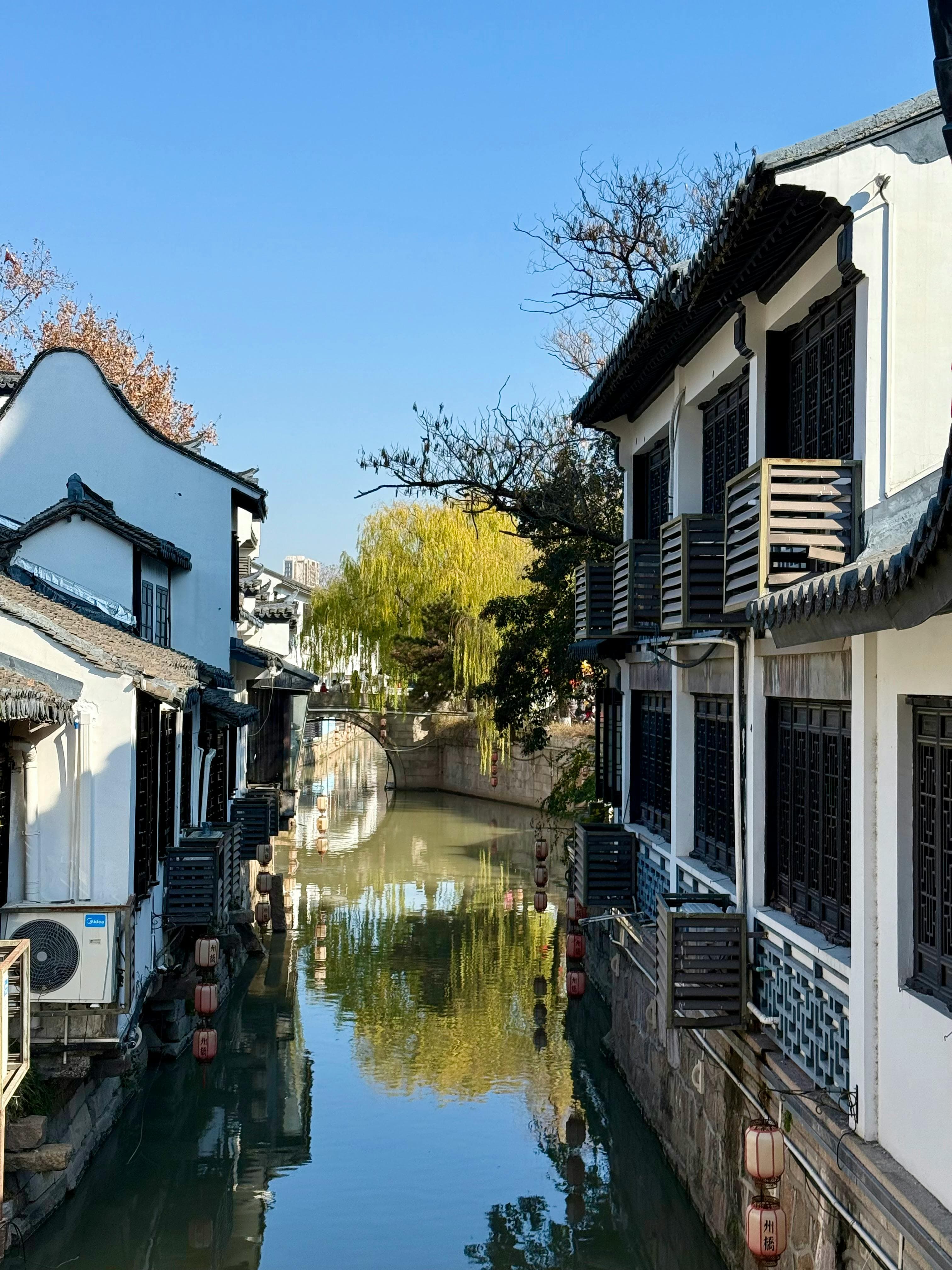
If the gardens are Suzhou's soul, the canals are its circulatory system. Suzhou was historically called "Venice of the East" by Marco Polo (though whether he actually visited remains debated among historians). What is certain is that the city's network of canals, stone bridges, and whitewashed buildings creates one of the most atmospheric urban landscapes in China. And unlike some restored tourist zones, this is largely authentic — people still live in the lane houses (though many have been converted into guesthouses, cafés, and shops).
Pingjiang Road (平江路) is the main pedestrianized canal street and the obvious starting point. It runs roughly north-south for about 1.6 kilometers parallel to the main canal. The northern section near the museum end tends to be quieter; the southern section near the Panmen Gate gets more commercial. Along the way you will find teahouses where you can take a break on a terrace overlooking the water, silk shops selling everything from cheap scarves to hand-embroided qipao dresses, and restaurants serving Suzhou-style dishes at outdoor tables right beside the canal.
For a boat ride, several operators offer trips along Pingjiang Road's canal in traditional covered boats (called guchuan, 古船). A 30–40 minute ride costs around ¥80–150 per boat (not per person) depending on negotiation and season. Evening rides when the lanterns are lit along the banks are particularly nice. The boat drivers often know local history and will point out former residences of notable figures — though language can be a barrier if you do not speak Mandarin.
Shantang Street (山塘街), west of the old town center, is the other major canal district. It is longer, more commercial, and frankly more crowded than Pingjiang Road, but it has a different character — more bustling market energy, more food stalls, and a lively bar scene in the evenings. The stretch from the Grand Canal bridge inland is the most picturesque part. Shantang has been continuously inhabited for over 1,200 years and was famously praised by Tang Dynasty poet Bai Juyi, who served as governor of Suzhou and helped construct the canal road itself.
Getting there: Both Pingjiang Road and Shantang Street are accessible by metro (line 1 for Pingjiang Road area, line 2 for Shantang Street) plus a short walk or bus ride. Taxis and DiDi work fine within the old city. This Suzhou tourism map shows the layout of the historic districts.
Silk, embroidery, and crafts
Suzhou has been China's silk capital since the 14th century, and the craft traditions built around silk — especially Su Xiu (苏绣, Suzhou embroidery) — remain living practices here rather than museum pieces. If you have any interest in textiles, craftsmanship, or just buying something beautiful to take home, Suzhou delivers.
The Suzhou Silk Museum (苏州丝绸博物馆) near the old town's north gate covers the full story of sericulture (silkworm farming), weaving technology, and fashion history across Chinese dynasties. Entry is free or low-cost, displays are well-curated in both Chinese and English, and the gift shop sells genuine silk products at reasonable fixed prices — no haggling required. Plan 1–2 hours.
For Su embroidery specifically, the Suzhou Embroidery Museum (苏州刺绣博物馆) showcases some of the most technically astonishing needlework you will ever see. Su Xiu is one of China's four major embroidery styles, known for double-sided embroidery (the image looks correct from both sides of the fabric), extremely fine stitching (some pieces use threads thinner than hair), and subjects ranging from traditional cats-and-peonies to contemporary portraits. Pieces by master embroiderers sell for thousands or tens of thousands of RMB, but smaller souvenir items (scarves, fans, handkerchiefs) are affordable.
Shopping tip: the area around Renmin Road (人民路) and Guanqian Street (观前街) has concentrated silk and embroidery shops. State-run stores like Suzhou Silk (苏州丝绸) charge fixed prices and offer certificates of authenticity. Market stalls and small shops may negotiate but quality varies enormously. If you are spending serious money on a piece of embroidery or a silk garment, ask for the artisan's signature and a certificate of origin — reputable sellers provide these.
Buying online afterward: If you fall in love with Su embroidery but cannot decide in person, Taobao (China's eBay) has enormous selection — search 苏绣 or 苏州刺绣. International shipping requires a forwarding service, but Superbuy or Bhiner can help. For certified heritage-level pieces, contact the Suzhou Embroidery Research Institute directly.
Tiger Hill and beyond
Tiger Hill (虎丘, Hǔqiū) is Suzhou's most significant historic site outside the garden circuit. The hill gets its name from a legend about a tiger that guarded the tomb of King Helü of Wu, who died in 496 BC and was reportedly buried here with 3,000 swords as grave goods. Whether the tomb (and the swords) actually exist beneath the hill is unknown — archaeologists have never excavated fully. But the site has been a popular scenic spot for over 2,000 years, and Su Dongpo (that same Song Dynasty poet from Hangzhou) supposedly said: "It is a pity to visit Suzhou without seeing Tiger Hill."
The main attraction is the Tiger Hill Pagoda (云岩寺塔), a seven-story brick pagoda built in 961 AD that leans noticeably to one side — it has been called China's Leaning Tower of Pisa. The lean started during construction due to soft ground foundations and has been monitored ever since. You cannot climb inside (it has been closed for structural reasons for decades), but the exterior view from the base of the hill is striking enough.
Beyond the pagoda, the hill is landscaped with gardens, pools, rockeries, and various pavilions linked by paths that wind up and around the summit. The Sword Pool (剑池) at the foot of the pagoda is where legend says King Helü's swords were hidden — the water is surprisingly clear and you can sometimes see carved rock inscriptions beneath the surface. The whole complex takes about 2 hours at a relaxed pace.
Other worthwhile sights in the broader Suzhou area: the Hanshan Temple (寒山寺), made famous by a Tang Dynasty poem that every Chinese schoolchild memorizes ("Outside the Hanshan Temple, at midnight the bell rings / on the passenger boat, I mourn my homesickness"). The temple bells ring on New Year's Eve in a ceremony that draws huge crowds. The Suzhou Museum designed by I.M. Pei (opened 2006) is a masterpiece of modern architecture that references traditional Suzhou garden design — geometric, light-filled, and completely free to enter. It sits right next to the Humble Administrator's Garden, making for an easy combination visit.
Practical info: Tiger Hill is about 5 km northwest of the city center — take bus or DiDi (15–20 minutes). Hanshan Temple is about 4 km west. The Suzhou Museum requires advance booking via their official WeChat mini-program or website — slots fill up quickly on weekends. All three sites have entry fees under ¥100.
Suzhou food: sweetness done right
Suzhou cuisine (苏帮菜, Sūbāng cài) shares DNA with Hangzhou's style — both are branches of Jiangnan (lower Yangtze) cooking characterized by fresh ingredients, precise technique, and a noticeable sweetness. But Suzhou has its own specialties that you will not find elsewhere, and the city takes its food seriously.
The dish everyone talks about is Squirrel-shaped Mandarin Fish (松子桂鱼, sōngshǔ guìyú) — a whole mandarin fish, deboned, scored in a cross-hatch pattern, deep-fried until the flesh fans out like a squirrel's tail, then coated in a bright red sweet-and-sour sauce. It is theatrical, delicious, and appears on nearly every Suzhou restaurant menu. De Yuan Teahouse (得月楼) near the Humble Administrator's Garden is the classic place to try it, though prices reflect the location and reputation.
Other Suzhou originals: Biluochun shrimp (碧螺虾仁) — river shrimp stir-fried with Biluochun tea leaves, similar to Hangzhou's Longjing shrimp but using Suzhou's own famous green tea grown on nearby Dongshan Mountain. Sichuan-style dishes here are milder than the real thing from Sichuan province — look for Suxiu braised pork (苏绣红烧肉) which is essentially dongpo rōu with a Suzhou twist. In autumn, hairy crab (大闸蟹) from nearby Yangcheng Lake is a seasonal obsession — restaurants across the city offer multi-course crab feasts from October through December, and prices range from reasonable to eye-watering depending on the provenance claimed for the crabs.
Breakfast in Suzhou deserves attention. Look for sunda bing (酥大饼, flaky sesame cakes), tang tu zi (糖粥, sweet rice porridge with red bean paste), and sheng jian bao (pan-fried soup dumplings) — different from Shanghai's version, typically rounder and sweeter. The morning markets around Shilin (石路) and Guanqian Street areas are where locals eat before work.
For restaurant recommendations: Dianping (search 苏州美食 or specific dish names) is essential for reading recent reviews. Ctrip/Trip.com lists English-friendly options. The Michelin Guide Suzhou covers the upper end. And honestly, some of the best meals happen in the small restaurants tucked down alleyways off Pingjiang Road — walk around dinner time, follow your nose, and pick somewhere busy with Chinese families.
Day trips from Suzhou
Tongli Water Town (同里古镇), about 30 minutes by bus or taxi from Suzhou, is one of the best-preserved water towns in the region. Less commercialized than Zhouzhuang (which gets the bulk of day-trip crowds from Shanghai), Tongli retains residential life alongside its tourist infrastructure. The Retreat & Reflection Garden (退思园) inside Tongli is itself a UNESCO-listed garden — small but exquisite. Rent a wupeng chuan (covered wooden boat) for a canal tour through the town. Half-day trip minimum.
Zhouzhuang (周庄), about an hour from Suzhou, is the most famous water town in China and correspondingly crowded. Its canals, stone bridges, and Ming/Qing dynasty architecture are undeniably photogenic — it has appeared on countless postcards and in films. But be prepared for crowds, especially on weekends and holidays. Go very early (before 8 AM) or stay overnight when the day-trippers leave and the town becomes almost peaceful again. Shen Hall (沈厅) and Zhang Hall (张厅) are the two main historic residences open to visitors.
Taihu Lake (太湖), about 40 km west of Suzhou, is China's third-largest freshwater lake and produces the famous hairy crabs (Yangcheng Lake, where the best ones allegedly come from, is actually a bay of Taihu). The area around Dongshan (东山) and Xishan (西山) islands offers hiking, fruit orchards (loquats in spring, oranges in autumn), and lakeside dining. The Taihu National Wetland Park on the northern shore is good for birdwatching in winter months when migratory birds stop over.
Kunshan (昆山), between Suzhou and Shanghai, is worth a stop if you are interested in Kunqu opera (昆曲) — one of the oldest forms of Chinese opera and a UNESCO Intangible Cultural Heritage. The Kunqu Opera Museum in Kunshan city center is small but well-done, and evening performances are held regularly during peak seasons.
Getting there and away
Suzhou has two railway stations: Suzhou (苏州站) is the main station, located conveniently close to the old city center — walkable to Pingjiang Road in about 20 minutes or a short taxi/metro ride. Suzhou North (苏州北站) serves mostly high-speed trains passing through on the Beijing-Shanghai line and is farther from the city center (about 20 minutes by taxi). Always confirm which station when booking tickets.
From Shanghai Hongqiao: 25–35 minutes by high-speed train, over 100 services daily, tickets from ~¥40. From Hangzhou East: 70–90 minutes, ~¥75–100. From Nanjing: 60–90 minutes, ~¥100. Book via 12306 (official) or Trip.com (English interface).
Within Suzhou, the metro system (currently 4 lines covering most major sights) is clean, efficient, and easy to navigate with bilingual signage. Buses cover everywhere else. Taxis and DiDi are inexpensive for short-to-medium distances. Bikes (HelloBike dominant) work well in the flat old city but less so in newer districts.
Shanghai Pudong Airport is the nearest international gateway — about 2 hours from Suzhou by a combination of train to Shanghai + airport link, or 2.5 hours by direct airport bus (check current schedules at Shanghai Airport's transfer page). Wuxi Sunan Shuofang Airport (WUX) is closer (about 40 km) but has far fewer international flights.
When to visit and where to stay
Spring (March–May) and autumn (September–November) are ideal. Spring brings the gardens to life — plum blossoms in March, cherry blossoms in April, peonies in May at the Humble Administrator's Garden. Autumn has comfortable temperatures (15–25°C), clear skies, and the start of hairy crab season in October. These are also the busiest periods, so book accommodation ahead.
Summer (June–August) is hot (30–35°C) and humid, with the meiyu rainy season in June. The gardens are lush but you will sweat. Upside: fewer tourists than spring/autumn peaks, lower hotel rates, and the lotus flowers at the Humble Administrator's Garden are spectacular in July.
Winter (December–February) is quiet, cold (0–10°C), and occasionally snowy. The gardens have a stark beauty in winter that summer visitors never see. Many outdoor teahouses reduce hours. Hotel prices hit their annual lows. Good time to visit if you want the gardens almost to yourself.
Where to stay: the Gusu (old city) district puts you within walking distance or a short ride of all the major gardens, Pingjiang Road, and the Suzhou Museum. This is the obvious choice for first-time visitors. Options range from luxury hotels like the Pan Pacific Suzhou near Panmen Gate to mid-range business hotels and traditional courtyard guesthouses (民宿). Search Booking.com, Trip.com, and Agoda — compare across platforms because pricing varies significantly for the same property. For a unique stay, look at the converted courtyard houses (园林客栈) within the old town lanes — book well in advance as supply is limited.
Confirm your entry path before booking.
Run the visa checker with your exact passport and itinerary. It turns this guide into a route you can execute.