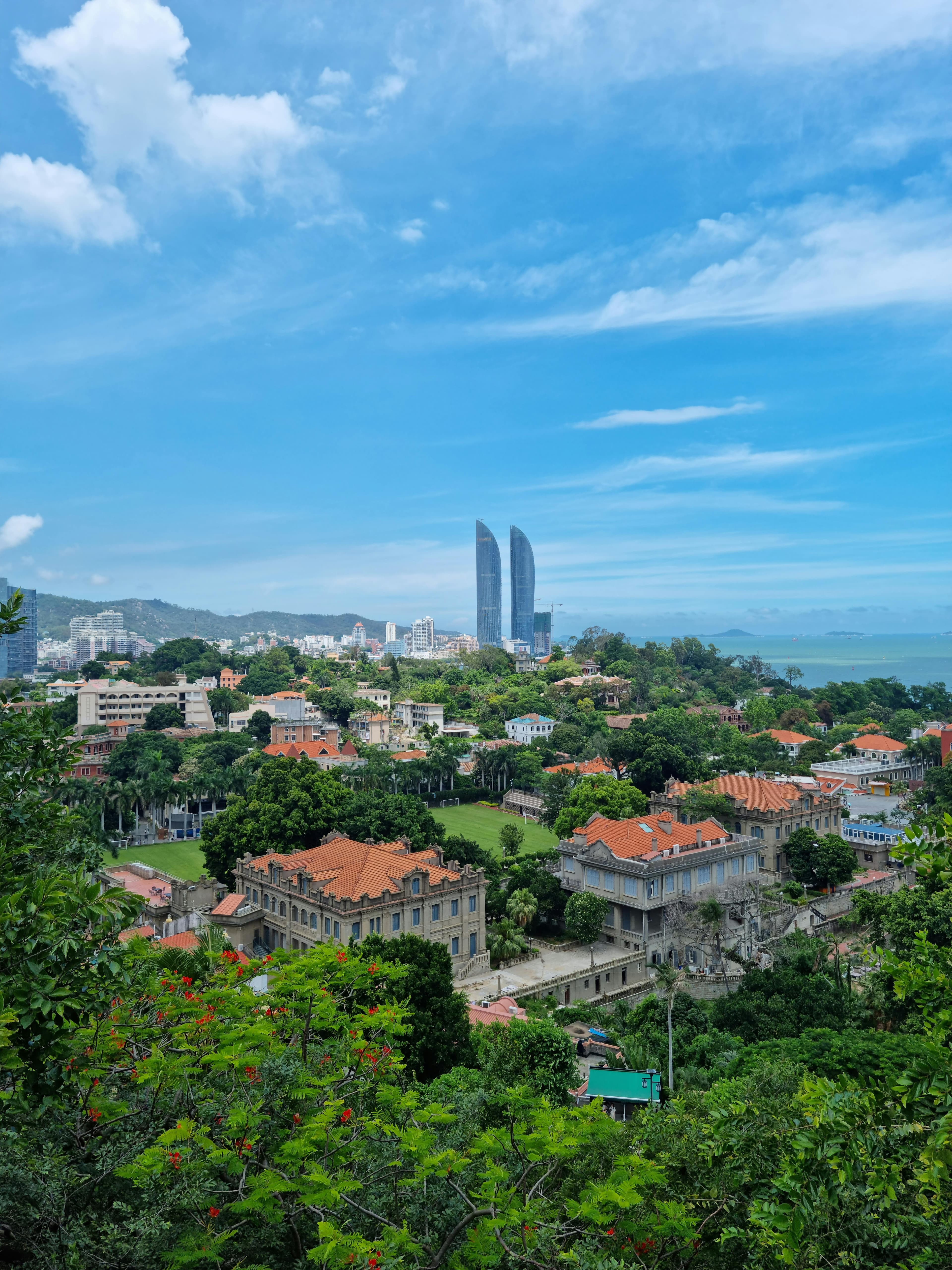
Gulangyu — the car-free island
Gulangyu (鼓浪屿, Gǔlàngyǔ) is the reason most people come to Xiamen. A small island (about 1.88 square kilometers) sitting in Xiamen Harbour just a 20-minute ferry ride from downtown, it has no cars, no bicycles, and a concentration of colonial-era architecture that earned it UNESCO World Heritage status in 2017 as a unique example of Sino-Western cultural exchange through architecture and urban planning.
The island was a foreign concession area from 1903 to 1941, during which time Western merchants, missionaries, and diplomats built consulates, churches, hospitals, schools, and private residences in styles ranging from Victorian veranda houses to Art Deco villas to Neo-Classical institutional buildings. After 1949, many of these buildings were repurposed as housing, offices, or left to decay. Since the tourism boom of the 2000s, significant restoration work has been done — some buildings are now museums, others house cafés and boutique hotels, and many remain residential homes for the roughly 15,000 people who still live on the island full-time.
Getting there: ferries depart from Xiamen International Cruise Centre (厦门国际邮轮中心) in the north of the city — NOT from the old ferry terminal near downtown (that route is now reserved for local residents). You need to book tickets in advance via the official WeChat mini-program or website because daily visitor numbers are capped. Ferry fare includes the return trip (valid for 20 days). The crossing takes about 20 minutes. First ferries start around 7 AM; book an early slot if you want any chance of experiencing the island before the tour groups arrive around 9–10 AM.
Once on the island, everything is on foot. Wear comfortable shoes — the island is hilly with lots of stairs and winding paths. The main sights include Sunlight Rock (日光岩), the highest point at 92 meters with panoramic views of Xiamen across the water; Shuzhuang Garden (菽庄花园), a seaside garden built by a wealthy Taiwanese family in 1913 with a piano museum inside; the former consular buildings along Gangzai Road (港仔后); and the narrow lanes of the old town where you will find independent shops, tea houses, and street food stalls tucked between colonial villas.
Resources: The UNESCO listing provides architectural and historical context. Xiamen Ferry official site handles ticket bookings. Gulangyu travel guide posts current opening hours and regulations. For accommodation on the island, search Booking.com or Trip.com for converted villa guesthouses — staying overnight lets you experience the island after the day-trippers leave, which is when it becomes genuinely peaceful.
Xiamen Island itself
Xiamen proper (the main island, not counting Gulangyu) is where most visitors actually spend their nights, and it deserves more than just being treated as a launchpad for Gulangyu. The city is consistently ranked among China's most livable — clean air by Chinese standards, wide tree-lined avenues, decent beaches within city limits, and a pace that feels noticeably slower than Shanghai, Guangzhou, or even Hangzhou.
Siming District (思明区) is the core. Zhongshan Road (中山路), the pedestrianized shopping street running from the waterfront inland, is Xiamen's commercial spine — less flashy than Nanjing Road in Shanghai but with better architecture (arcade-style shophops with continuous covered walkways, a legacy of the Southeast Asian influence on the city). The side streets off Zhongshan hold some of Xiamen's best eating: look for satay noodles (沙茶面, shāchá miàn), oyster omelette (海蛎煎, hálì jiān), and the various peanut soup (花生汤, huāshēng tāng) shops that have been operating for decades.
The University District around Xiamen University (厦门大学, Xiàmén Dàxué) — consistently one of China's most beautiful campuses with its mix of South Fujian and Western architectural styles — anchors a youthful neighborhood full of cafés, bookstores, small galleries, and affordable restaurants catering to students. The campus itself requires advance reservation to visit (book via their official system — slots fill quickly). Adjacent to the university is Nanputuo Temple (南普陀寺), an active Buddhist temple dating back to the Tang Dynasty that sits at the foot of Wulao Peak (五老峰) with hiking trails leading up to hilltop views over the university and coastline.
Huandao Road (环岛路) is Xiamen's signature coastal drive — a scenic road hugging the island's southeastern shore for about 43 kilometers, passing beaches, parks, sculpture installations, and seafood restaurants. Rent a bike (widely available along the route) and ride the section between the International Conference Centre and Hulishan Fortress for the best combination of ocean views and manageable distance (about 10 km round trip). The beach at Baicheng (白城沙滩), right next to Xiamen University, gets crowded on weekends but is convenient. Further east, the beaches around Huangcuo (黄厝) and Zengcuolan (曾厝垵) are cleaner and less packed.
Zengcuolan (曾厝垵), a former fishing village turned arts-and-crafts district, is worth a walk-through evening stroll. It has become quite touristy (think Tianzifang in Shanghai or Kuanzhai Alley in Chengdu levels of commercialization), but the laneways between the souvenir stalls still have interesting independent shops, live music venues, and seafood barbecue spots. Best experienced after dark when the lights come on and the energy picks up.
Fujian tea culture — this is the real deal
Fujian province is arguably China's most important tea region. It is the birthplace of oolong tea (specifically Tieguanyin / 铁观音 from Anxi county in southern Fujian), produces some of China's most sought-after black teas (Lapsang Souchong / 正山小种 from the Wuyi Mountains), and grows white tea (白茶, notably Silver Needle / 白毫银针) in Fuding and Zhenghe counties. Xiamen, as Fujian's historic port city and cultural gateway, has absorbed all of these traditions into its daily life in a way that goes far beyond casual tea drinking.
Kung fu tea (功夫茶, gōngfū cha) — the Fujianese style of brewing tea using small clay teapots, tiny cups, multiple rapid infusions, and elaborate pouring techniques — is practiced everywhere in Xiamen: in homes, in offices, in market stalls, in hotel lobbies. If someone offers you tea in Xiamen, accept. It is not just hospitality; it is a cultural practice that runs deep in this region. The basic ritual: rinse the teapot and cups with hot water, add tea leaves (generously — maybe a third to half the teapot volume), pour hot water (85–95°C depending on tea type) over the leaves, immediately discard the first infusion (it washes the leaves), then serve successive infusions into tiny cups. Good oolong can be infused 7–10 times before losing flavor.
For buying tea, Xiamen has several options. The wholesale tea markets near the railway station area offer enormous selection at competitive prices — knowledgeable buyers can find excellent Tieguanyin, Dahongpao (大红袍, another famous oolong from Wuyi Mountain), and white teas here. Be aware that quality varies enormously and prices can range from ¥100/kg to ¥10,000+/kg for the same "type" of tea depending on harvest season, specific origin, and processing method. If you do not know what you are doing, start small and taste before committing to larger purchases. Many vendors offer free tastings — this is normal and expected.
The Xiamen Tea Export Corporation showroom and several heritage tea houses along Zhongshan Road offer more curated experiences with English-speaking staff who can explain the differences between tea varieties. For a deeper dive, consider a day trip to Anxi County (安溪), about an hour's drive from Xiamen, which is the heartland of Tieguanyin production. Tea plantations cover the hillsides, and many farms welcome visitors for tastings and tours.
Tea resources: World Tea Directory covers Fujian tea varieties. Tea Guardian has detailed guides on oolong brewing technique. For purchasing, Taobao (search 安溪铁观音 or 武夷岩茶) ships internationally via forwarding services like Superbuy.
Xiamen and southern Fujian food
Fujian cuisine (闽菜, Mǐn cài) is one of China's eight great culinary traditions, and Xiamen represents its southern (Minnan / 闽南) branch. Minnan food emphasizes fresh seafood, light seasoning, soups, and a distinctive use of savory-sweet flavor combinations that reflect both the region's maritime abundance and its historical trade connections with Southeast Asia (many overseas Chinese in Malaysia, Singapore, Indonesia, and the Philippines trace their roots to this exact region, and the food shows it).
Dishes you should actively seek out:
- Satay Noodles (沙茶面, shāchá miàn) — The dish that defines Xiamen street food. A rich, aromatic broth made from satay sauce (peanut paste, sesame, spices, and dried seafood), served with rice noodles and your choice of toppings: pork intestines, liver, seafood, tofu puffs, duck gizzard. Every shop makes the broth slightly differently. Try a few places and pick your favorite. Wu Shun Ji (吴顺记) on Longbian Road is a well-regarded classic; Xin Yue Ji (新月记) near Zhongshan Road is another solid choice.
- Oyster Omelette (海蛎煎, hálì jiān) — Fresh oysters (from nearby Zhangzhou Bay, some of the best in China) mixed into an egg and starch batter, pan-fried until crispy on the edges and creamy in the center. Served with a sweet chili sauce. Best at hole-in-the-wall places where the oysters are shucked to order. Huang Ze He (黄则和) on Zhongshan Road is the famous name but honestly, follow locals to wherever looks busy.
- Fried Spring Rolls (春卷, chūnjuǎn) — Different from the thin Cantonese version. Fujian spring rolls use a thicker wrapper made from pre-cooked dough, stuffed with a dense filling of braised cabbage, mushrooms, shredded pork, carrots, and sometimes dried shrimp or bamboo shoots. Eaten year-round but especially during Lunar New Year. A Bao Jin (阿宝今) is often recommended.
- Peanut Soup (花生汤, huāshēng tāng) — A breakfast and dessert staple. Peanuts slow-cooked until they practically dissolve into a sweet, milky soup. Often served with a boiled egg, youtiao (fried dough stick pieces), or glutinous rice balls. Comfort food at its simplest. Huang Ze He (黄则和) again — they have been serving this since 1945.
- Seafood across the board — Xiamen sits on one of China's richest fishing grounds. Clams, crabs, groupers, sea bass, mantis shrimp, abalone, and seasonal specialties like bamboo clams (蛏子) appear on menus everywhere. The seafood restaurants along Yuwan Road (渔湾路) near the coast and the night market at第八市场 (Eighth Market, Dì Bā Shìchǎng) are good starting points. Prices vary wildly — always confirm the per-jin (500g) price before ordering, especially for live seafood.
- Bak Kut Teh (肉骨茶) — Yes, really. This pork rib herbal soup is associated with Singapore/Malaysia, but it originated among Fujianese immigrants and has made its way back home. Several Malaysian-Chinese run restaurants in Xiamen serve excellent versions.
Restaurant finder: Dianping (search 厦门美食 or specific dishes) is essential. Ctrip/Trip.com lists English-friendly options. For serious foodies, Fuchsia Dunlop's *Invitation to a Banquet* covers Fujian cuisine in depth. The Xiamen Foodie blog (independent) does honest reviews of local spots.
Jimei and beyond — the Tan Kah Kee story
Jimei (集美) is a district north of central Xiamen that holds one of the more remarkable stories in modern Chinese history. It was the hometown of Tan Kah Kee (陈嘉庚, 1874–1961), a Chinese businessman who made his fortune in Singapore and Malaysia and then proceeded to donate virtually all of it to education in China. Over his lifetime, he founded and funded over 100 schools in Jimei alone — from primary schools to Xiamen University (which he established in 1921 and funded personally for the first 16 years) to Jimei University and dozens of others. The collection of schools, libraries, and institutional buildings he commissioned forms the Jimei School Village (集美学村), an architectural ensemble blending traditional Chinese elements with Western construction techniques that remains visually striking today.
Tan Kah Kee's former residence (归来堂, Guīlái Táng) is now a museum documenting his life and philanthropy. The story is genuinely inspiring — a man who gave away an estimated USD $150+ million (in today's money) to education while living relatively modestly himself. The complex also includes the Turtle Garden (鳌园, Áoyuán), an unusual mausoleum and memorial park featuring hundreds of stone carvings depicting historical scenes, moral fables, and calligraphy specimens set into the walls of an open-air gallery surrounding Tan's tomb.
Getting there: metro line 1 to Jimei School Village station (集美学村站), about 30 minutes from downtown Xiamen. The school village is free to wander; individual museums may have small entry fees. Plan 2–3 hours if you are interested in the history, 1 hour if you just want to see the architecture.
Day trips from Xiamen
The Fujian Tulou (福建土楼) are the region's most extraordinary architectural attraction — massive circular or square earthen buildings built by the Hakka people between the 12th and 20th centuries as fortified communal housing. Each tulou could house an entire clan — up to 800 people — living in rooms arranged around a central courtyard, sharing wells, kitchens, and defensive positions against bandits. They look like something out of a science fiction movie: giant circular mud-brick donuts rising three to five stories from the rice paddies, with only one entrance and no windows on the ground floor.
The nearest tulou clusters to Xiamen are in Nanjing (南靖) county, about 2 hours by bus or car. The most photogenic ones include Chengqi Lou (承启楼) in Gaobei village — the "king of tulou," a massive circular building with four concentric rings of rooms; Hegui Lou (和贵楼), a square tulou built on soft marshland that somehow supports five stories of rammed earth; and the "Four Dishes and One Soup" (四菜一汤) cluster viewable from Tianluokeng village, where four circular tulous and one square tulou are arranged in a pattern that resembles (you guessed it) a table setting. This is the shot that appears on every postcard and UNESCO brochure.
Day trips from Xiamen are possible but tight — expect a 10–12 hour day. Better to stay overnight in one of the tulou villages (several offer guesthouse rooms inside actual tulou buildings, which is a memorable experience in itself). Book through Ctrip or Xiamen tour operators. Independent travel by bus from Xiamen long-distance bus station to Nanjing county, then local transport to the villages, is entirely feasible and cheaper than organized tours.
Quanzhou (泉州), about 1 hour by high-speed train from Xiamen, was the starting point of the Maritime Silk Road and one of the world's great port cities between the 10th and 14th centuries. Marco Polo reportedly departed from here. Today it is a living museum of religious diversity — Kaiyuan Temple (one of China's largest Buddhist temples), the Qingjing Mosque (one of the oldest mosques in China, built in 1009), Manichaean temples, Christian churches, and Taoist shrines coexist within a few blocks of each other. Quanzhou was named a UNESCO City of Gastronomy in 2021 — its food scene (especially beef dishes and snacks like meat dumplings and frozen sago soup) is outstanding. Easily combined with a tulou trip as an overnight stopover.
Tulou resources: The UNESCO Fujian Tulou page covers background and significance. Nanjing County Tourism posts practical visiting information. This tulou photography guide shows what to expect visually.
Getting to and around Xiamen
Xiamen Gaoqi International Airport (XMN) is unusually close to the city center — about 12 km, making it one of the most convenient major airports in China. Metro line 1 connects directly (about 20 minutes to downtown), or a taxi/DiDi takes 15–25 minutes depending on traffic. The airport serves domestic routes extensively plus international flights to Southeast Asian hubs (Singapore, Kuala Lumpur, Bangkok, Manila), Northeast Asian cities (Seoul, Tokyo, Osaka), Amsterdam (via Xiamen Airlines), and other destinations depending on season.
Xiamen North Station (厦门北站) is the high-speed rail hub, handling trains to/from Fuzhou (1.5–2 hours, ~¥100–130), Shanghai (5–6 hours, ~¥280–350), Shenzhen (3.5 hours, ~¥180–220), and most other destinations. Xiamen Station (厦门站) is older, closer to the city center, and serves conventional rail plus some high-speed services. As always, confirm which station when booking.
Within Xiamen, the metro system (currently 3 lines covering the main island and connecting districts) is clean and efficient. Buses are comprehensive and cheap. Taxis and DiDi are widely available. Bike-sharing works excellently on the flat coastal areas — Huandao Road is particularly good for cycling. Getting to Gulangyu requires the ferry from the International Cruise Centre (see above).
Transport apps: 12306 for trains. DiDi for rides. Xiamen Ferry for Gulangyu tickets. Alipay transit QR works on metro and buses.
When to visit and where to stay
Autumn (September–November) is Xiamen's best season. Temperatures hover between 22–28°C, humidity drops from summer extremes, typhoon risk diminishes after October, and skies are generally clear. October is particularly pleasant — warm enough for beach days, cool enough for comfortable walking around Gulangyu. Seafood is at its best in autumn as waters cool and shellfish fattens up for winter.
Spring (March–May) is mild (18–26°C) but wetter — April and May bring frequent showers and occasional fog rolling in off the Taiwan Strait. Not ideal for Gulangyu views or beach activities, but perfectly fine for eating, tea shopping, and indoor sightseeing. Spring Festival period (January/February) brings huge crowds of domestic tourists — avoid if possible unless you enjoy peak-season chaos.
Summer (June–August) is hot (28–33°C), humid, and carries typhoon risk (July–September is peak typhoon season). Flights and ferries can be disrupted. Upside: swimming weather, lively beach atmosphere, and the lowest hotel rates outside of holiday periods. Many businesses close or reduce hours during the hottest part of the afternoon (2–4 PM) — plan accordingly.
Winter (December–February) is mild by mainland standards (10–18°C) and is actually the driest season. Too cold for swimming but perfect for walking, sightseeing, and tea tasting. Fewer tourists mean shorter queues at popular restaurants and easier Gulangyu ferry bookings. Hotel prices hit annual lows.
Where to stay: the Zhongshan Road / Siming District area puts you walking distance from the ferry terminal (for Gulangyu), the best food streets, and metro access. This is the obvious choice for first-time visitors. Options range from international brands like Xiamen Marriott Hotel and Pan Pacific Xiamen to mid-range business hotels and boutique guesthouses. Near Xiamen University gives a younger, more local vibe with plenty of student-priced dining options. On Gulangyu itself, staying overnight in a converted villa is a worthwhile splurge for at least one night — book well ahead via Booking.com, Trip.com, or Agoda. Compare platforms because pricing varies significantly.
Confirm your entry path before booking.
Run the visa checker with your exact passport and itinerary. It turns this guide into a route you can execute.